

The supplement industry makes the decision complicated on purpose. A confusing market — one with hundreds of products, competing claims, and no required verification — is a profitable market. Keep the consumer uncertain and they keep buying.
The evidence does not point to complexity. It points to a short list of interventions consistently supported across decades of research, at a dose that does not require a calculator, for athletes at every competitive level.
Here is the honest list.
1. Creatine Monohydrate
Creatine monohydrate is one of the most studied performance supplements. Across 69 trials, creatine combined with resistance training improved strength more than placebo (Kazeminasab et al., 2025). The International Society of Sports Nutrition formally positions it as the most effective ergogenic nutritional supplement currently available to athletes.
It works by increasing the availability of phosphocreatine in muscle tissue, which the body uses to regenerate ATP — the primary energy currency — during high-intensity efforts: sprints, heavy lifts, explosive movements. More available ATP regeneration means more work capacity, faster recovery between efforts, and over time, greater training adaptations.
The evidence-supported dose is 3–5 grams daily. No loading phase is required. No cycling on and off. Just a consistent daily dose, ideally with water or a carbohydrate source.
What to look for: creatine monohydrate specifically — not HCL, buffered, or ethyl ester forms, which lack comparable research. Third-party tested for purity, with an HPLC assay result above 99% from an independent laboratory.
PeakFusion’s Micronized Creatine Monohydrate — 5g per serving, unflavored, tested at 100.8% assay by an independent lab, with the Certificate of Analysis publicly available.
2. Vitamin D3
Vitamin D receptors are found in tissues throughout the body, and vitamin D is involved in calcium absorption, bone mineralization, muscle contractile function, and immune regulation. It is not a performance enhancer — it is a physiological baseline. When you are deficient, everything downstream from those processes operates below capacity.
Low vitamin D is more common than most athletes expect. A meta-analysis of 2,313 athletes found 56% below 32 ng/mL, with higher risk in winter and in indoor sports (Farrokhyar et al., 2015).
The body synthesizes D3 primarily from direct UVB sunlight exposure. For a college student in the Midwest spending most of the day in class or training indoors, adequate synthesis is not reliably achievable during winter and shoulder seasons. Supplementation with D3 (cholecalciferol — the form the body synthesizes naturally, not D2) is the straightforward correction.
PeakFusion’s Vitamin D3 — 2,000 IU label claim. The current lot, VS240798, has heavy metals in spec by independent ICP-MS/MS testing, and its potency assay is pending; results are on the lab results page. Softgel format for fat-soluble absorption.
3. A Complete Multivitamin
The case for a multivitamin is not that it optimizes performance. It is that it closes the coverage gaps a reasonable athletic diet still leaves. Demanding academic and training schedules make optimal dietary variety difficult in practice, even with good intentions.
In national survey data, adults who took a multivitamin had lower rates of falling short on most vitamins and minerals than those who did not (Blumberg et al., 2017). One daily serving covers the basics without buying each nutrient separately.
The quality threshold to look for: third-party verified label claims, clear doses on the label, and independent testing for heavy metals and microbiological contamination.
PeakFusion’s Complete Multivitamin — full-spectrum formula, tested via HPLC, ICP-MS, and microbiological analysis, with the Certificate of Analysis publicly available.
What Is Not on the List
Pre-workout stimulants, BCAAs, fat burners, testosterone boosters, proprietary blends, adaptogens, and most products in the sports nutrition aisle: none have the research profile, practical necessity, or safety track record of the three above.
Pre-workout stimulants produce acute performance effects but do not drive long-term adaptation, are frequently adulterated in independent testing, and add stimulant load to a demographic that typically does not need more. BCAAs are redundant when total protein intake is adequate. Fat burners are largely unsupported and frequently contaminated with unlabeled stimulants.
The three-supplement list is not a minimal approach. It is an accurate one — the honest summary of what decades of research consistently supports for the foundation of an athletic supplement protocol.
The Trinity Stack
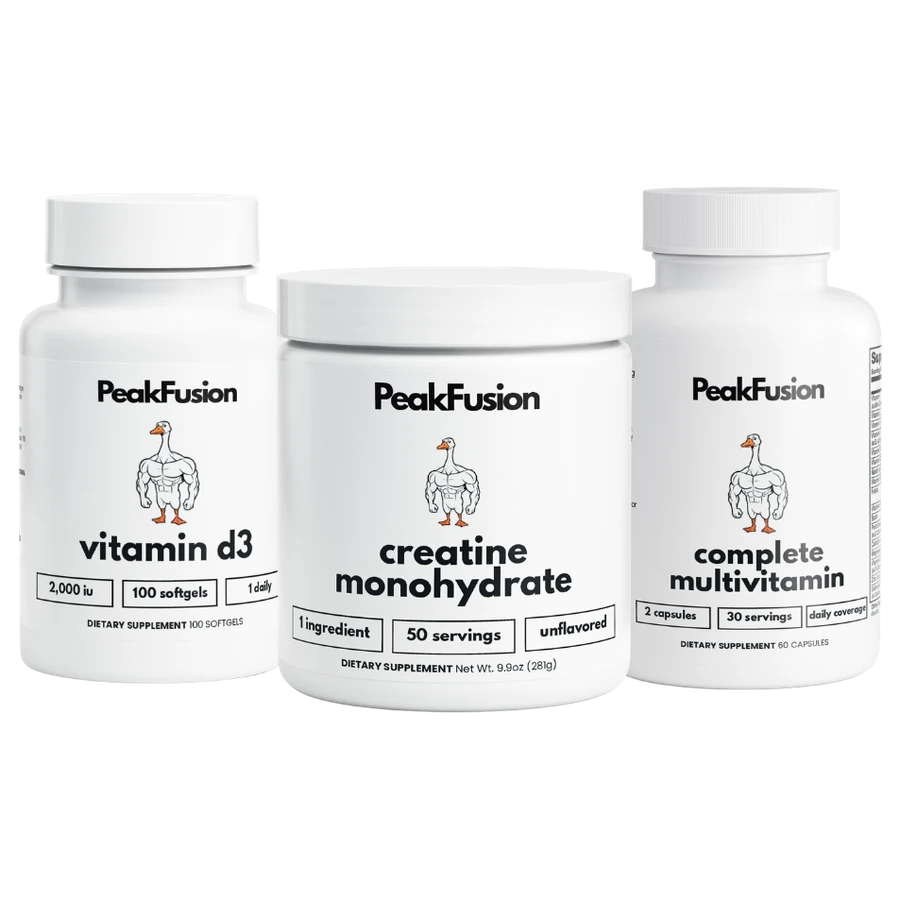
PeakFusion bundles all three as The Trinity Stack — all three products, each independently tested with the Certificate of Analysis publicly available. It is the cleanest way to cover the foundation in a single purchase. It covers the basics most athletes ask about.