


Lot B25I013. Appearance complies. Identity complies by TLC. Lead, arsenic, and cadmium conform at 1 PPM max. All microbiological tests passed.
The Science
No mystery claims. No hidden lab work.
Every PeakFusion product is built around evidence-supported ingredients, appropriate dosing, and independent third-party testing. The results are published before the checkout.
Lot MMV250805. Thiamine and niacin label claims verified by HPLC. Heavy metals passed by ICP-MS. Microbiological testing passed via Petrifilm and qPCR.
Lot VS240798. Arsenic, cadmium, lead, and mercury all within spec by ICP-MS/MS. The potency assay is not on file yet, so no measured IU figure is published. The result goes on the lab results page when it is complete.
Evidence-based ingredients
What the research actually says.
Creatine Monohydrate
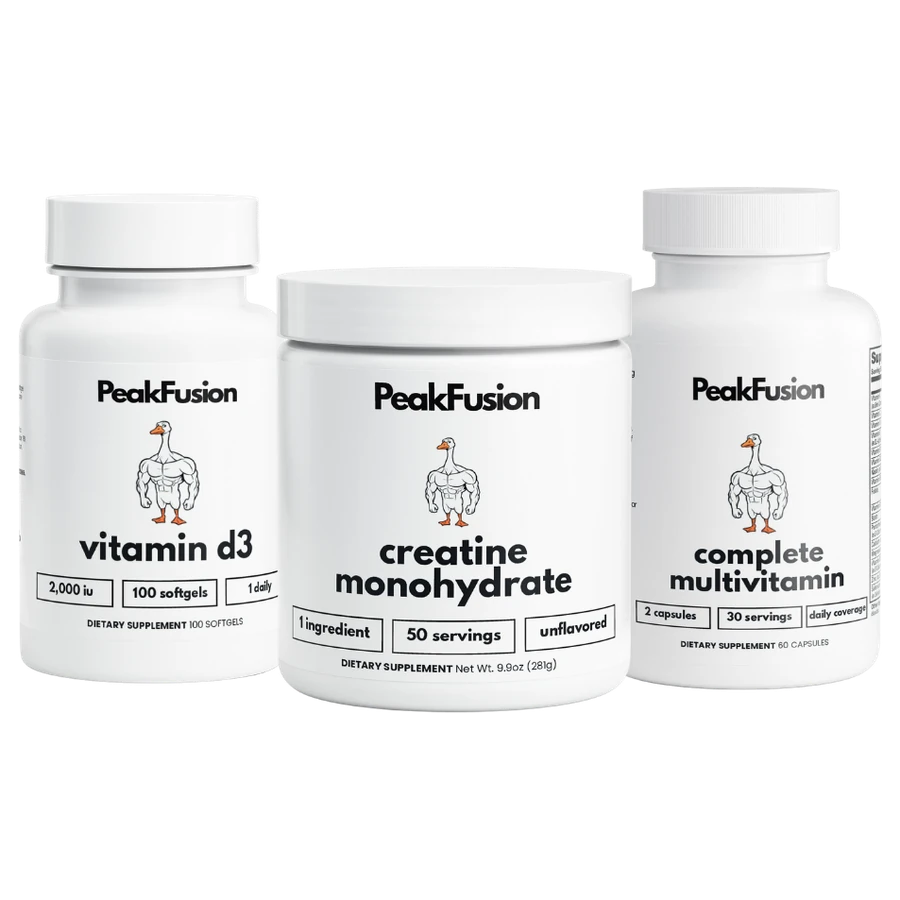
Creatine monohydrate is one of the most studied supplements in sports nutrition. The International Society of Sports Nutrition calls it the most effective ergogenic supplement available for high-intensity exercise capacity when combined with training (Kreider et al., 2017). Across 69 trials, creatine with resistance training improved strength more than placebo (Kazeminasab et al., 2025). PeakFusion uses 5 g, within the 3 to 5 g daily dose used in research.
Vitamin D3
Vitamin D3 (cholecalciferol) supports calcium absorption, bone density, skeletal muscle contractile function, and immune defense. Levels shift with the seasons: in U.S. lab testing data, they tended to peak in September and were lowest in March (Kroll et al., 2015). The NIH sets the adult upper limit at 4,000 IU a day. In a controlled trial, D3 was about 87% more potent than D2 at raising and maintaining blood vitamin D levels (Heaney et al., 2011).
Complete Multivitamin
Many U.S. adults fall short on some vitamins and minerals from food alone, and multivitamin users had lower rates of falling short in national survey data (Blumberg et al., 2017). One two-capsule serving covers your B vitamins and zinc, with smaller amounts of magnesium and calcium, without buying each separately. Daily micronutrient coverage and routine simplification, not a cure-all. Tested via HPLC, ICP-MS, and microbiological analysis.
Sources
Where these claims come from.
- Kreider et al., 2017. International Society of Sports Nutrition position stand on creatine supplementation. J Int Soc Sports Nutr. Read the paper
- Kazeminasab et al., 2025. Creatine with resistance training and strength, across 69 trials. Nutrients. PubMed
- Blumberg et al., 2017. Multivitamin use and nutrient intake in U.S. adults, national survey data. Nutrients. PubMed
- Kroll et al., 2015. Seasonal pattern of vitamin D levels in the United States, peaking in September and lowest in March. PLoS One. PubMed
- Heaney et al., 2011. Vitamin D3 is more potent than vitamin D2 in humans. J Clin Endocrinol Metab 96(3):E447-52. PubMed
- NIH Office of Dietary Supplements. Vitamin D fact sheet for health professionals. Read the fact sheet
Transparency is built into the buying experience.
Every lot number, test result, and method is publicly available. No login required.

