
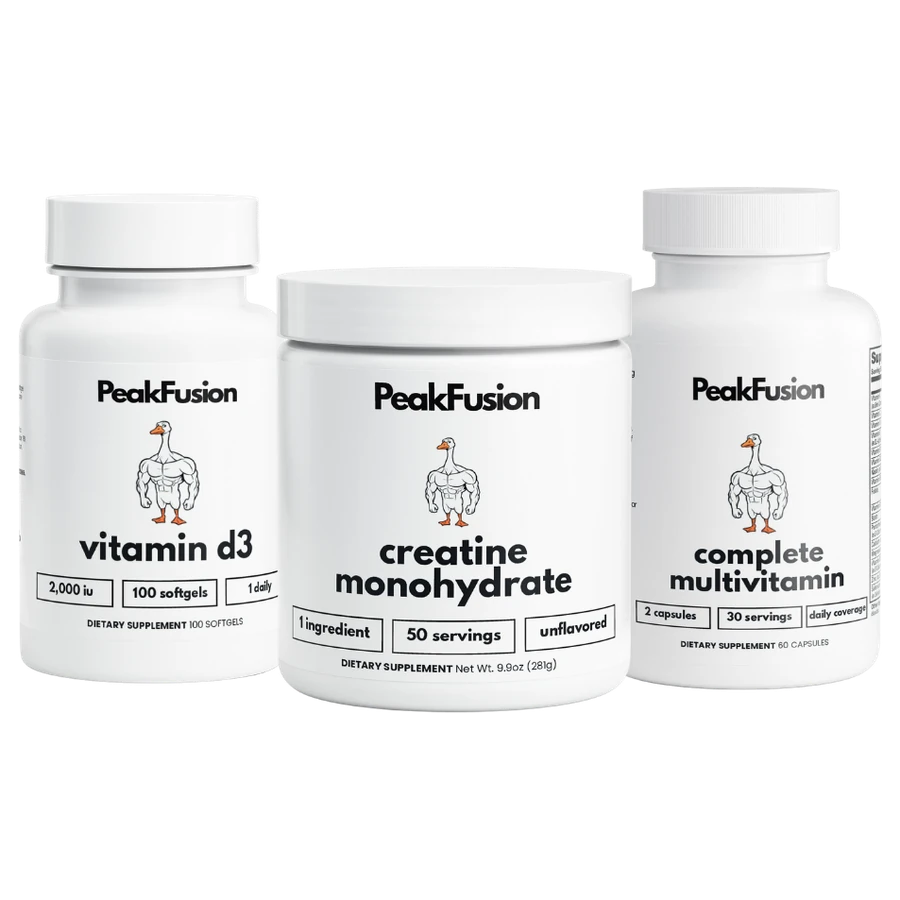


Most multivitamins already include some vitamin D3, and PeakFusion's Complete Multivitamin is no exception. The amount is usually smaller than people assume though, often less than half of what an adult needs in a day. If you take a daily multivitamin and nothing else, there is a real chance you are still short on vitamin D, especially in the fall and winter months. Here is how to check your own numbers and decide whether a separate D3 softgel makes sense alongside what you are already taking.
What is actually in a multivitamin's vitamin D
Multivitamins are built to cover a broad spread of nutrients in small amounts, not to max out any single one. PeakFusion's Complete Multivitamin label lists 10 mcg of vitamin D per two-capsule serving, which converts to 400 IU. That number is public on the Supplement Facts panel and in the product description, and it is listed separately from the standalone Vitamin D3 2,000 IU softgel for exactly this reason: they are not the same dose, and one is not a substitute for the other.
This is not a flaw specific to PeakFusion. Multivitamins across the category tend to carry modest vitamin D amounts, because the format has to leave room for twenty-plus other nutrients in one or two capsules. A dedicated vitamin D product can devote its entire capsule to a single nutrient, which is why standalone D3 softgels typically carry a much higher dose than the D3 folded into a multivitamin.
The reference numbers that matter
The National Institutes of Health Office of Dietary Supplements sets the Recommended Dietary Allowance (RDA) for vitamin D at 15 mcg, or 600 IU, per day for adults ages 19 to 70. That figure is meant to cover nearly the entire healthy population, not just an average person. The same NIH fact sheet sets the Tolerable Upper Intake Level (UL) at 100 mcg, or 4,000 IU, per day for adults, covering vitamin D from food, beverages, and supplements combined. Going over the UL on a single day occasionally is not the same as a sustained daily habit above it, but the UL is the number a doctor would reference if dosing came up.
Lay those two numbers next to what is actually in each PeakFusion product, and the gap is easy to see:
| Source | Vitamin D3 per day | Percent of adult RDA (600 IU) | Percent of the upper limit (4,000 IU) |
|---|---|---|---|
| Complete Multivitamin alone | 400 IU | 67% | 10% |
| Vitamin D3 2,000 IU softgel alone | 2,000 IU | 333% | 50% |
| Both together | 2,400 IU | 400% | 60% |
Taken alone, the multivitamin's 400 IU falls short of the 600 IU RDA. Taken alone, the D3 softgel clears the RDA by a wide margin on its own. Taken together, the combined 2,400 IU sits well under the 4,000 IU upper limit, which is the detail most people assume will be a problem and almost never is at these doses.
When stacking the two makes sense
A single-nutrient shortfall is not automatically something to fix. Diet, sun exposure, and skin tone all affect how much vitamin D a person is actually getting outside of supplements, and a multivitamin's 400 IU might be the difference-maker for someone who already eats fortified dairy and gets regular sun. The calculation changes for a few common situations:
- Training indoors most of the year, which is the norm for a lot of winter and early-spring sports schedules.
- Living somewhere north of about the 37th parallel, which covers all of Indiana, where the sun's angle in winter is too low for skin to produce much vitamin D regardless of time spent outside.
- Limited dairy or fortified-food intake, since fortified milk is the single largest source of dietary vitamin D in the United States.
- A known low vitamin D result from bloodwork, which is the only way to actually confirm a deficiency rather than infer one from dosage math.
The piece on vitamin D3 deficiency in athletes goes deeper on how common low vitamin D actually is in trained populations, and the vitamin D3 dosage guide breaks down the amounts in more detail. Training itself does not change a vitamin D number. The sun exposure, diet, and supplement choices around training do, and the stack is there to support those choices, not to produce a result on its own.
How to check your own multivitamin
Three steps, in order:
- Find the Supplement Facts panel on the multivitamin you actually take, not a different product in the same line, and look for vitamin D or vitamin D3 listed in mcg or IU.
- Add up every vitamin D source you take daily, including a separate D3 softgel if you already use one, plus any fortified foods you eat consistently.
- Compare the total to the 600 IU RDA and the 4,000 IU upper limit above. A gap toward the RDA is a reasonable case for adding a D3 softgel. A total already near or past the upper limit is a reason to cut back, not add more.
PeakFusion publishes the full lab testing behind both products, lot by lot, on the lab results page, including the current multivitamin lot (MMV250805) and vitamin D3 lot (VS240798). The vitamin D3 lot's heavy-metals panel is complete and in spec, and its potency assay is still pending as of this writing, which is stated plainly on that page rather than filled in with an old lot's number.
Frequently asked questions
Does a multivitamin count as my vitamin D source?
It counts toward the total, but check the label amount before assuming it covers the full RDA. PeakFusion's Complete Multivitamin provides 400 IU, which is 67% of the 600 IU adult RDA on its own.
Can I take a vitamin D3 softgel and a multivitamin on the same day?
Yes. Taking both is a common and straightforward way to reach or exceed the RDA, and the combined total from PeakFusion's two products (2,400 IU) stays well under the 4,000 IU upper limit for adults.
How much vitamin D is too much?
The NIH sets the upper limit at 4,000 IU per day for adults from food, beverages, and supplements combined. A higher short-term dose is sometimes used under medical supervision to correct a diagnosed deficiency, which is a different situation from a daily supplement routine.
What is the difference between vitamin D2 and D3 in supplements?
D3 (cholecalciferol) is the form most research supports for raising and sustaining blood levels, and it is the form used in both PeakFusion products. D2 (ergocalciferol) is the other common supplement form and tends to be less effective at raising blood levels for the same dose.
Does adding creatine to this change anything?
No. Creatine absorbs through a different pathway than vitamin D3 and does not affect the vitamin D math above. Can you take creatine and vitamin D3 together covers that pairing directly, for anyone combining all three in the Trinity Stack.
Should I buy the Trinity Stack or just add a D3 softgel to my multivitamin?
Either gets you the same combination of products. The Trinity Stack bundles creatine, the multivitamin, and the D3 softgel for $85 one time and clears the $75 free shipping minimum on its own. It does not carry its own subscription, since Shopify's bundle structure does not support one, so the usual path is to start with the Trinity Stack and then put the multivitamin and D3 on individual subscriptions afterward if you want each to keep refilling automatically.
Shop this
Complete Multivitamin: $34 one time, or $28.90 with Subscribe and Save, delivered every month.
Vitamin D3 2000 IU: $26 one time, or $22.10 with Subscribe and Save, delivered every 14 weeks.
The Trinity Stack: $85 one time, includes creatine, the multivitamin, and the D3 softgel, and clears the $75 free shipping threshold. The Trinity Stack is a one-time purchase only. Subscribe to the multivitamin and D3 individually afterward if you want ongoing refills.
This article is general information, not medical advice. Talk to a doctor before starting or combining supplements if you are pregnant, nursing, under 18, or managing a health condition.


