


Updated November 2026
More than half of athletes tested in published research come back below an adequate vitamin D level. A 2015 meta-analysis pooling 23 studies and 2,313 athletes found 56% (95% CI 44 to 67%) had levels below 32 ng/mL, with the risk highest in winter and early spring and in indoor sports (Farrokhyar et al., 2015). That number holds up across sports and latitudes, including the Midwest.
How Common Is Deficiency Among Athletes?
Published estimates vary based on population, season, sport, and the cutoff used to define low status. The Farrokhyar meta-analysis above found risk rose significantly in winter and spring (relative risk 1.85) and in indoor sports (relative risk 1.19), with mixed indoor/outdoor sports showing the widest range (relative risk 2.54). Using the stricter NIH cutoff of 20 ng/mL, a 2022 review estimated about 30% of adult athletes fall below it, likely an underestimate because few studies were done in winter (Harju et al., 2022).
Athletes are not a protected population. Indoor training, geographic latitude, and limited sun exposure during training seasons all contribute to inadequate vitamin D synthesis regardless of overall fitness level or dietary quality.
Why Athletes Are Specifically at Risk
Vitamin D3 (cholecalciferol) is primarily synthesized in the skin through UVB radiation from direct sunlight. The synthesis pathway is efficient under the right conditions, but it requires conditions that many athletes do not consistently meet:
| Risk factor | Why it lowers vitamin D | Who it affects most |
|---|---|---|
| Indoor training | No meaningful UVB exposure during gym, court, or arena sessions | Basketball, volleyball, wrestling, swimming, and winter-sport athletes |
| Geographic latitude | At Boston's latitude (42.2°N), researchers reported winter sun produced no measurable vitamin D in skin from November through February (Webb et al., 1988). Indiana sits just south of that, so winter synthesis is still limited | Anyone training in the northern Midwest, roughly Indiana and north |
| Season | Across millions of U.S. lab tests, one analysis found vitamin D levels peaked in late summer and were lowest in late winter (Kroll et al., 2015) | Anyone whose main training season runs through the winter |
| Skin tone | Darker skin produces less vitamin D from the same sun exposure | Athletes with more melanin, independent of fitness level |
For a college athlete in Indiana, Ohio, Michigan, or anywhere in the northern Midwest, training primarily indoors or outdoors in the early morning and evening, adequate sun-based vitamin D synthesis is structurally difficult for a substantial portion of the year.
What Deficiency Does to Athletic Performance
Muscle Function
Vitamin D receptors are present in skeletal muscle tissue. Vitamin D supports normal muscle function. In athletes whose levels are already adequate, supplementation has not been shown to improve strength overall (Han et al., 2024), so the goal is maintaining adequate status, not a performance boost. Training is still what drives strength and conditioning gains; the stack supports the training, not the other way around.
Bones and Immune Function
Vitamin D helps the body absorb calcium and supports normal immune function. These are the reasons the NIH lists adequate vitamin D status as a baseline nutrition goal for everyone, athletes included.
D3 vs. D2: Which Form Actually Works
Two forms of vitamin D are available in supplements: D2 (ergocalciferol, derived from plants) and D3 (cholecalciferol, the form produced in human skin). D3 is consistently shown to be more effective at raising and sustaining serum 25(OH)D levels, the primary biomarker of vitamin D status.
A 2012 meta-analysis in the American Journal of Clinical Nutrition concluded that D3 is more effective than D2 at raising serum 25(OH)D, with the clearest difference seen when vitamin D is given in larger, less frequent doses (Tripkovic et al., 2012). That is why D3 is the form most supplements use, including ours.
Dosing: What the Research Supports
The NIH Office of Dietary Supplements sets the adult RDA at 600 IU daily (800 IU for adults over 70) and the adult tolerable upper intake level at 4,000 IU daily. A 2,000 IU daily dose sits within that range, and how much vitamin D3 athletes actually need walks through the full dosing math. If you also take a daily multivitamin, here is whether that already covers enough vitamin D on its own, and if you also take creatine, here is whether the two interact (they do not). If you want to know your own level, a 25(OH)D blood test through your doctor is the accurate way to check.
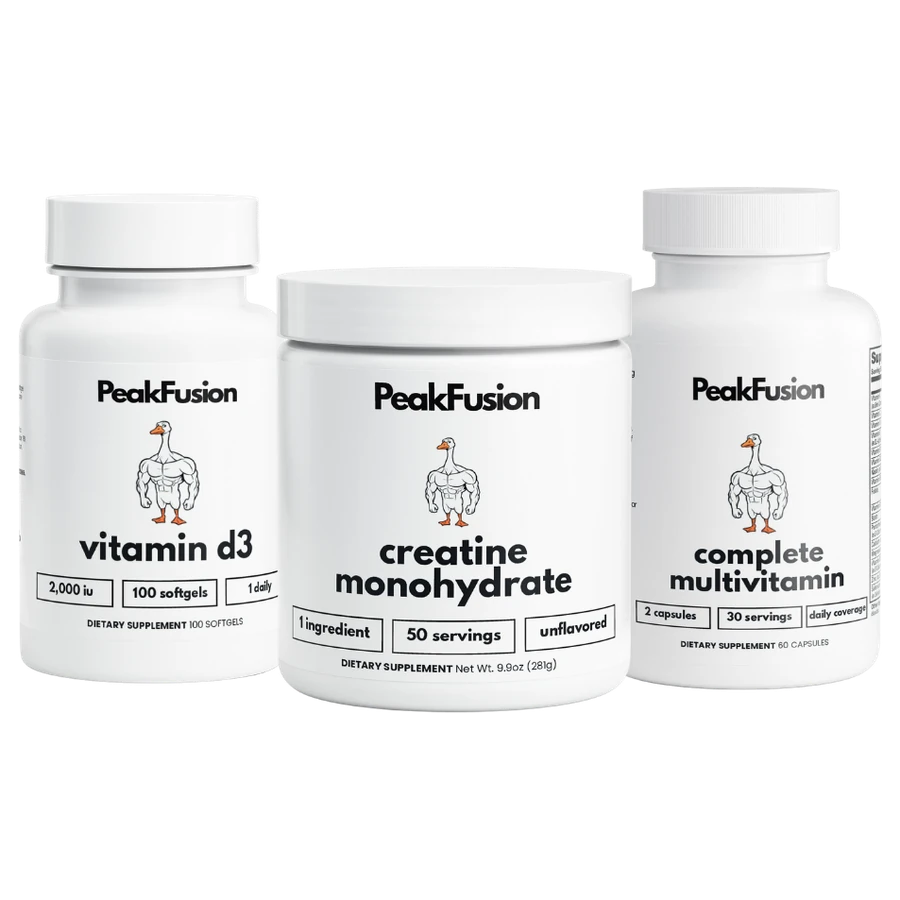
PeakFusion's Vitamin D3 provides 2,000 IU per softgel as cholecalciferol, the form the research supports. Every lot has its test results published, with the lot number, on our lab results page, so you can verify the exact bottle you are holding. The softgel format supports fat-soluble absorption, so take it with a meal containing fat.
Frequently Asked Questions
What blood level actually counts as "deficient"?
It depends on whose cutoff you use, which is part of why published estimates vary. The NIH's own reference points are a serum 25(OH)D under 12 ng/mL for deficiency and 12 to 20 ng/mL as generally inadequate for bone and overall health, with 20 ng/mL and above considered generally adequate. Much of the sports-science research on athletes, including the studies cited above, uses a stricter research cutoff of 20 to 32 ng/mL to flag "inadequate" status, which is why an athlete-specific study can report a higher percentage below target than the NIH's own baseline would suggest. Either way, a blood test is the only way to know your own number.
Can diet alone fix a vitamin D shortfall?
Usually not completely. The NIH's own fact sheet states that obtaining sufficient vitamin D from food sources alone is difficult, and that fortified foods and some sun exposure are generally necessary on top of diet, with a supplement sometimes needed depending on the person. Fatty fish and fortified dairy help, but they rarely close the gap on their own for someone training mostly indoors through the winter.
Does a daily multivitamin already cover this?
Possibly only part of it. PeakFusion's Complete Multivitamin provides 400 IU of vitamin D per serving, which is 67% of the 600 IU adult RDA on its own but well under the 2,000 IU in the standalone D3 softgel. Vitamin D3 and a multivitamin: do you need both walks through the exact math.
Does taking creatine change any of this?
No. Creatine and vitamin D3 absorb through unrelated pathways, so taking one does not change how the other works. Can you take creatine and vitamin D3 together covers that pairing directly, including for anyone taking all three in the Trinity Stack.
Is 2,000 IU enough if you are already deficient?
For maintaining an adequate level once you are already there, yes, it sits comfortably above the RDA and well under the upper intake level. For correcting an existing deficiency, some people are prescribed a higher short-term dose by a doctor based on an actual blood test, then step back down to a maintenance amount like 2,000 IU. That decision belongs to a blood test and a doctor, not a guess based on how tired someone feels in January.
shop this
our Vitamin D3 2,000 IU softgel is $26 one time, or $22.10 when you subscribe and save 15%, refilling automatically every 14 weeks so you are not reordering mid-winter when you need it most. it also comes bundled into the Trinity Stack with creatine and our Complete Multivitamin for $85 one time, which clears the $70 free-shipping threshold on its own. the Trinity Stack does not carry its own subscription, a Shopify platform limit on bundled products, so the usual path is to start there and then subscribe to each product individually afterward.
The Practical Takeaway
Low vitamin D is common in athletic populations, especially in winter and in indoor sports, and it is simple to address with a daily supplement and, if you want to know your own number, a blood test. For athletes training in northern latitudes without consistent midday sun exposure, a daily D3 supplement is one of the most evidence-supported baseline interventions available.
this article is general information, not medical advice. talk to a doctor before starting any new supplement or increasing your dose beyond the label, especially if you are under 18, pregnant, nursing, or managing a health condition.


