


Updated October 2026.
Third-party tested means an independent laboratory, with no financial relationship to the brand, has analyzed a specific production lot for identity, purity, heavy metals, and microbiological safety, and produced a Certificate of Analysis you can match to the lot number on your bottle. That is the whole definition. Everything else brands put around the phrase is marketing.
“Third-party tested” appears on bottles, websites, and social media across thousands of brands, often with no clarification of what was tested, by whom, or what the results showed. The phrase can mean almost anything, or it can mean something specific and verifiable. Here is how to tell the difference.
Why the FDA Does Not Solve This Problem
Unlike pharmaceutical drugs, dietary supplements in the United States do not require pre-market approval by the FDA. A brand can formulate a product, print a label, and begin selling it without ever proving the label is accurate. The FDA can act against a supplement after the fact, if contamination, adverse events, or fraud are demonstrated, but pre-market verification of label claims is not required by law.
This creates a structural gap: the burden of verifying label accuracy falls on the manufacturer, and there is no regulatory requirement to do so with independent oversight. Third-party testing exists to close that gap voluntarily.
What Third-Party Testing Actually Is
Legitimate third-party testing involves sending a production lot sample to an independent laboratory, ideally an accredited one, with no financial relationship to the brand, for analysis. The lab tests for:
- Identity: Is this actually the compound the label claims?
- Purity and assay: Is the quantity present what the label states?
- Heavy metals: Are lead, arsenic, mercury, and cadmium below safe thresholds?
- Microbiological safety: Is the product free from pathogens including E. coli, Salmonella, yeast, and mold?
The result is a Certificate of Analysis (COA): a document tied to a specific production lot number recording every test performed and every result obtained.
What “Third-Party Tested” Does Not Always Mean
The phrase without supporting documentation can mean almost anything:
- The brand tested raw ingredients but not the finished product
- Only one batch was tested, not every production lot
- Only one parameter (for example, heavy metals) was tested, not purity or identity
- The testing was conducted by a lab affiliated with the manufacturer
- The results were never published
A phrase on a label is not the same as accessible evidence. If a brand cannot produce a lot-specific Certificate of Analysis from an independent laboratory, “third-party tested” is a marketing claim, not a verified fact.
| A real, verifiable COA | A marketing claim alone |
|---|---|
| Published publicly, no form required | Available only on request, or not at all |
| Tied to a specific lot number | A generic document covering “all products” |
| Run by a lab independent of the brand | Run in-house or by an affiliated lab |
| Covers identity, purity, heavy metals, and microbiology | Covers one parameter, or discloses none |
| Lot number matches the bottle in your hand | No way to match the document to your bottle |
How to Verify a Supplement’s Testing Claims Yourself
The standard to look for:
- The COA is publicly accessible, not behind a form submission or available only on request
- The COA is tied to a specific lot number, not a generic document covering “all products”
- The testing laboratory is demonstrably independent of the brand
- The document covers identity, purity or assay, heavy metals, and microbiological testing
- The lot number on the document matches the lot number printed on your product
Find the lot number on your supplement (typically printed on the bottom or side panel), match it to the brand’s COA documentation, and verify the results. This is the complete chain of verification, and it takes about two minutes when the documentation is actually available. PeakFusion's newer bottles make this one step shorter: scan the label and the matching lot results open directly.
What PeakFusion Publishes
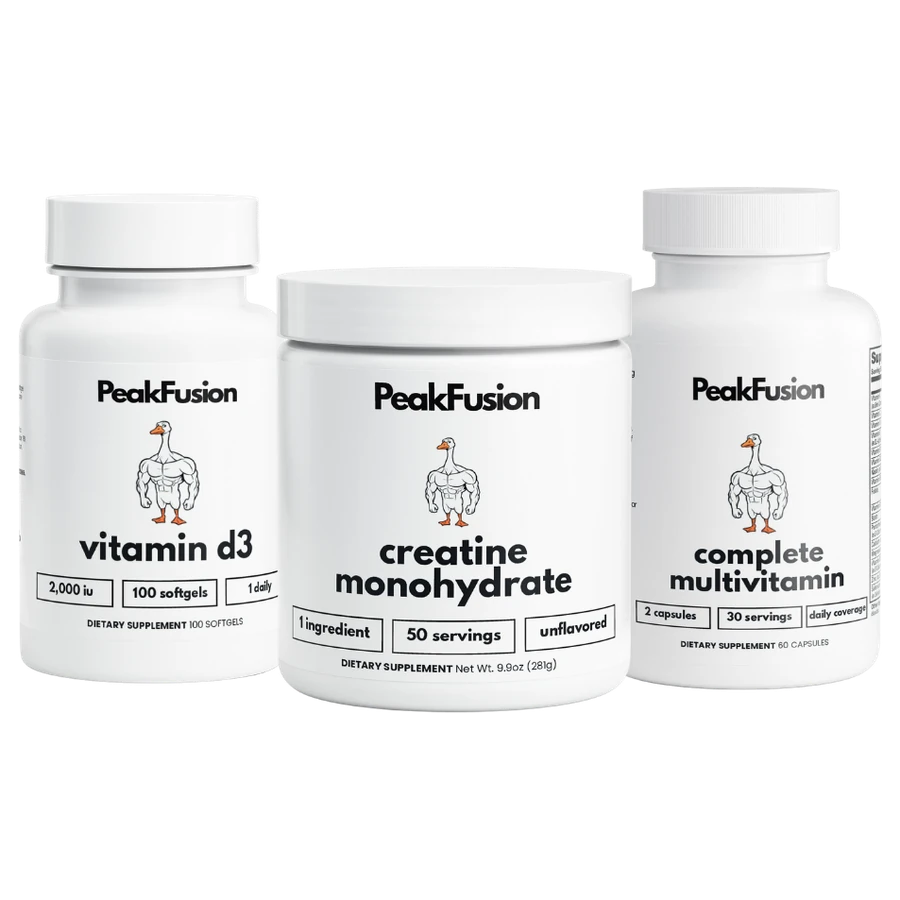
Every production lot of every PeakFusion product is tested by an independent third-party laboratory. Each lot's results are publicly available on the Lab Results page, with no account required and no form to fill out.
Current results: Creatine Monohydrate Lot B25I013 tested at 100.8% assay by liquid chromatography, heavy metals within limits, microbiological passed (see the full creatine COA breakdown). Complete Multivitamin Lot MMV250805: thiamine and niacin label claims confirmed by HPLC, heavy metals 4/4 in spec by ICP-MS, microbiological passed. Vitamin D3 Lot VS240798: heavy metals 4/4 in spec by ICP-MS/MS; potency assay pending, so only the 2,000 IU label claim is published.
Frequently Asked Questions
Does third-party testing mean the product is government approved?
No. Dietary supplements are not reviewed by the FDA before they go on sale, and no amount of third-party testing changes that. Third-party testing is an independent lab checking a specific lot for identity, purity, heavy metals, and microbiological safety, not a government signoff.
Is a “lab tested” badge the same as a published Certificate of Analysis?
No. A badge or seal on a label is a marketing claim unless it links to an actual, lot-specific COA from an independent lab. If you cannot find the document itself, the badge alone does not prove anything.
Does third-party testing cover every bottle, or just one batch?
It depends on the brand. Some test every production lot, others test a single batch once and apply the claim to everything that follows. Ask which lot the COA you are looking at actually covers, and check that lot number against your own bottle.
What is the difference between testing the raw ingredient and testing the finished product?
Raw-ingredient testing checks the material before it is encapsulated or powdered into the final product. Finished-product testing checks what actually ends up in the bottle, after manufacturing. A COA for the finished product is the stronger evidence, since manufacturing can introduce its own contamination or dosing issues.
Where do I find PeakFusion's COAs?
On the Lab Results page, organized by product and lot number, with no account or form required. If you are weighing the Complete Multivitamin against your morning coffee routine specifically, multivitamin and coffee answers that separate question directly.
Shop this.
- Micronized Creatine Monohydrate: $34 one-time, or $28.90 with subscribe and save, delivered every 7 weeks.
- Complete Multivitamin: $34 one-time, or $28.90 with subscribe and save, delivered monthly.
- Vitamin D3 2,000 IU: $26 one-time, or $22.10 with subscribe and save, delivered every 14 weeks.
Orders of $75 or more ship free in the US. The Trinity Stack bundles all three for $85 one-time and clears that threshold on its own. It does not carry its own subscription, so the way to keep it on autopilot afterward is to subscribe to each product individually, each on its own refill schedule.
Why Transparency Is a Higher Standard Than Compliance
Publishing COAs publicly, lot by lot, is not an industry requirement. It is a choice. The brands that do it are demonstrating that the results are verifiable. For athletes and health-conscious consumers, accessible third-party testing documentation is the clearest available signal that a supplement brand is being honest about what is in their products.


