
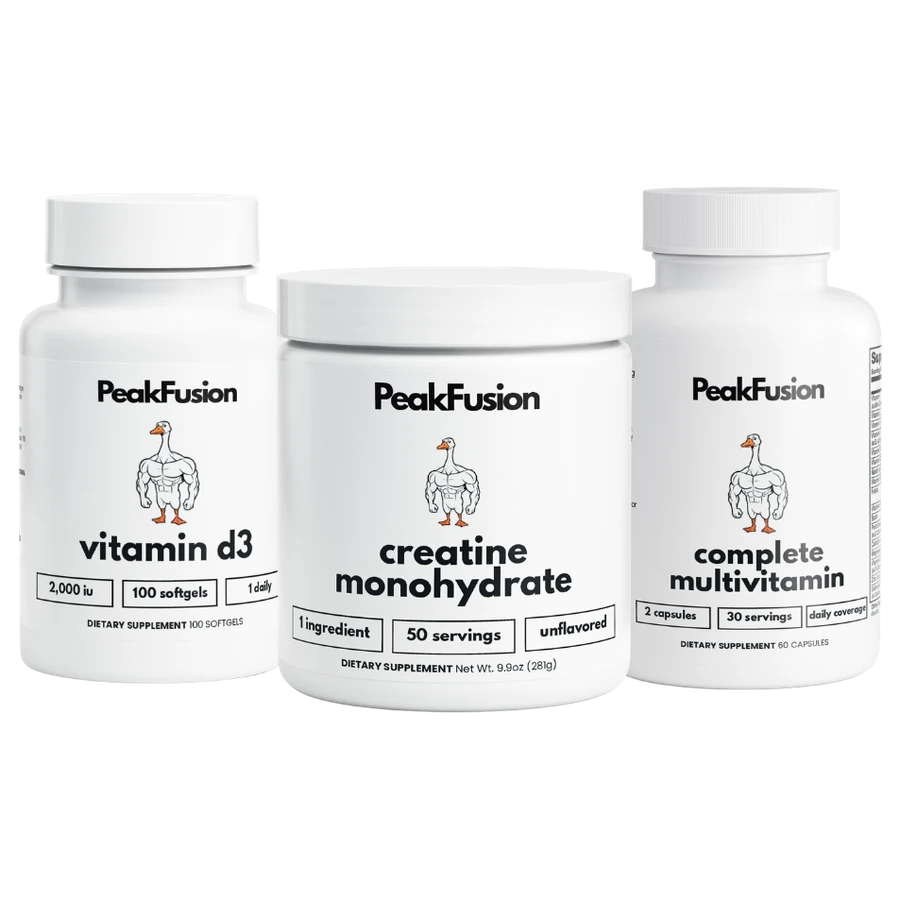
Lot B25I013. Appearance complies. Identity complies by TLC. Lead, arsenic, and cadmium conform at 1 PPM max. All microbiological tests passed.
The Science
No mystery claims. No hidden lab work.
Every PeakFusion product is built around evidence-supported ingredients, appropriate dosing, and independent third-party testing. The results are published before the checkout.
Lot MMV250805. Vitamins verified by HPLC. Heavy metals passed by ICP-MS. Microbiological testing passed via Petrifilm and qPCR.
Vitamin D3 keeps the serving simple at 2,000 IU per softgel. Check the lab results page for the current lot-specific COA and microbiological testing details.
Evidence-based ingredients
What the research actually says.
Creatine Monohydrate
Creatine monohydrate is one of the most studied supplements in sports nutrition. The International Society of Sports Nutrition calls it the most effective ergogenic supplement available for high-intensity exercise capacity when combined with training (Kreider et al., 2017). Across 69 trials, creatine with resistance training improved strength more than placebo (Kazeminasab et al., 2025). PeakFusion uses 5g, within the 3 to 5 g daily dose used in research.
Vitamin D3
Vitamin D3 (cholecalciferol) supports calcium absorption, bone density, skeletal muscle contractile function, and immune defense. Levels shift with the seasons: in U.S. lab testing data, they tended to peak in September and were lowest in March (Kroll et al., 2015). The NIH sets the adult upper limit at 4,000 IU a day. D3 is approximately 87% more effective than D2 at raising serum vitamin D levels.
Complete Multivitamin
Many U.S. adults fall short on some vitamins and minerals from food alone, and multivitamin users had lower rates of falling short in national survey data (Blumberg et al., 2017). One two-capsule serving covers B vitamins, zinc, magnesium, and more without buying each separately. Daily micronutrient coverage and routine simplification, not a cure-all. Tested via HPLC, ICP-MS, and microbiological analysis.
Sources
Where these claims come from.
- Kreider et al., 2017. International Society of Sports Nutrition position stand on creatine supplementation. J Int Soc Sports Nutr. Read the paper
- Kazeminasab et al., 2025. Creatine with resistance training and strength, across 69 trials. Nutrients. PubMed
- Tsiaras et al., 2026. Creatine and kidney function, across 20 randomized trials. J Ren Nutr. PubMed
- Blumberg et al., 2017. Multivitamin use and nutrient intake in U.S. adults, national survey data. Nutrients. PubMed
- Kroll et al., 2015. Seasonal pattern of vitamin D levels in the United States, peaking in September and lowest in March. PLoS One. PubMed
- NIH Office of Dietary Supplements. Vitamin D fact sheet for health professionals. Read the fact sheet
Transparency is built into the buying experience.
Every lot number, test result, and method is publicly available. No login required.