


I spent a class period at Westfield High School talking to a marketing class about how a real business works. I was not there to sell anything. Nobody in that room is my customer, and I did not bring product with me.
I am a sophomore at Indiana University's Kelley School of Business. I run PeakFusion Supplements. I am nineteen, and some of the people in that room are seventeen. That gap is small enough that the questions got specific fast.
Four came up more than any others. Here is what I told them.
Where do you actually get your products?
This was the first real question, and it is the thing most people get wrong about direct to consumer brands.
I do not own a factory. Almost nobody at my size does. Direct to consumer, or DTC, means I sell straight to the person using the product with no store in between. The manufacturing happens at an FDA registered, cGMP compliant facility in the United States.
cGMP stands for Current Good Manufacturing Practices. In plain terms, the facility has to prove what goes in the bottle. Test the raw ingredients, control the process, test the finished product, and keep records of all of it. It is a legal standard the FDA inspects and enforces, not a marketing phrase.
Here is the part that surprised the room. Supplements do not need FDA approval before they go on sale. The FDA can act after a product turns out to be unsafe or mislabeled, but nobody checks the contents in advance.
That is the entire reason third party testing matters. An independent lab with no financial tie to the brand confirms what is actually in the product. Plenty of brands say they test. Far fewer show you the results. We publish every Certificate of Analysis with the lot number on it, so you can match the lot printed on your bottle to the results on our lab results page.
Someone asked why more brands do not do that. I did not have a clean answer. The honest one is that it costs money and nobody makes you.
How do you balance running a business with being a student?
Badly, some weeks. That is the real answer and I gave it to them.
The version people expect is a productivity system. I do not have one worth teaching. What I actually have is a small number of things that have to happen every day, and permission to let everything else slide when a week gets bad.
Two things have helped more than any app.
The first is that the business is small on purpose. Three products instead of thirty. Fewer products means fewer decisions, fewer things to photograph, fewer things to explain, fewer things to test. Complexity is what eats a student founder's time, and most of it is self inflicted.
The second is that I stopped treating social life as the thing I sacrifice. I tried that. It does not work, and it makes you worse at the business, because most of what has actually grown PeakFusion came from people I know talking to people they know. The nights out are not competing with the work. Some weeks they are the work.
What I did give up is the idea that everything gets done. Something is always behind. Right now it is my email list.
How do you handle interviews and recruiting in college?
This one came up more than I expected, which makes sense. Kelley recruiting starts early and the students in that room are already thinking about it.
The most useful thing I have learned is that running something small gives you specific stories, and specific beats impressive every time. An interviewer has heard a hundred people say they are hardworking. They have not heard someone explain how they found out a supplement lot had expired documentation and what they did about it.
So the advice I gave was not about the business. It was this: whatever you are doing, do the version of it where you have to make real decisions with real consequences. A club where you actually run the budget teaches you more than an internship where you shadow someone. The stories come from the consequences.
The other thing I told them, because I wish someone had told me earlier: start before you feel ready. I did not know what a Certificate of Analysis was when I started. I learned it because I had to.
Why did you start PeakFusion?
Soccer, mostly.
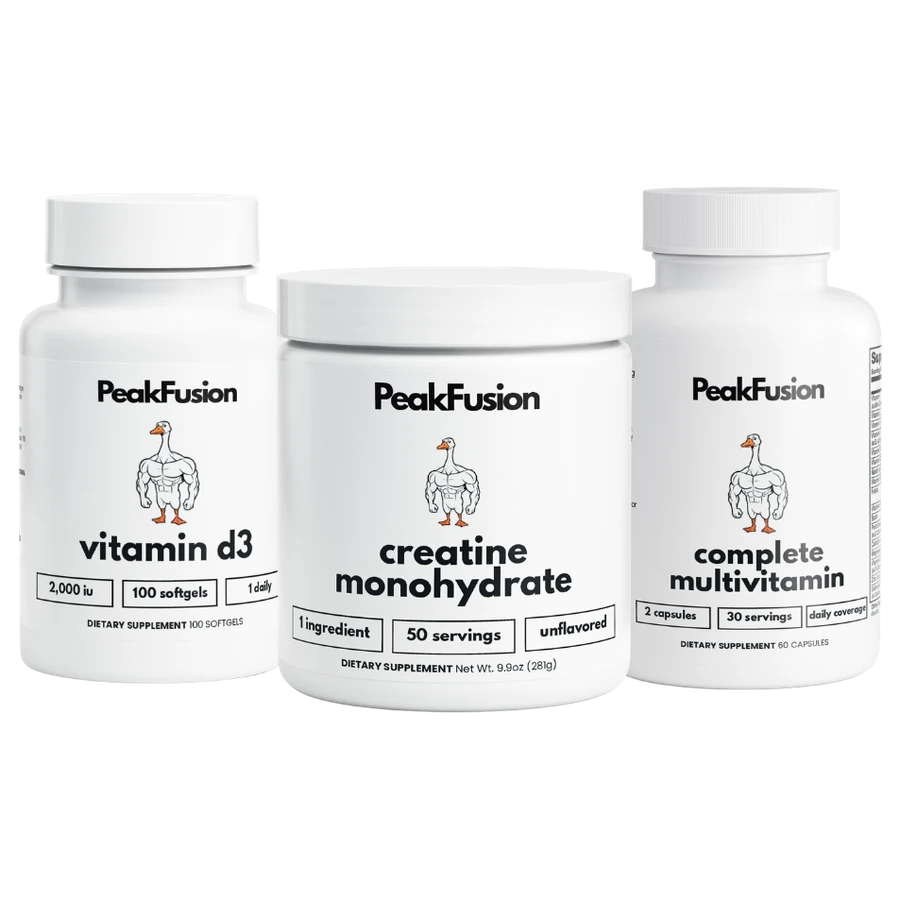
I played competitively for years, including with Indy Eleven and Hoosier FC, and I still train and track like an athlete. Somewhere in there I got serious about what I was putting in my body. Not hacks. Just the basics most athletes underrate: creatine, vitamin D3, and a complete multivitamin.
What I found was an industry built on confusion. Proprietary blends that hide the dose. Formulas with a famous ingredient at a fraction of the amount used in the research that made it famous. Claims with nothing behind them.
So I built the version I wanted to buy. Three products, each one chosen because human research supports it, each dosed the way the research dosed it, each tested by an independent lab with the results published for anyone to read.
I take all three every day. That is not a tagline. It is the reason the testing budget exists.
The thing I did not expect
I went in assuming the interesting part would be the product. It was not. The questions that got the most follow up were about the boring infrastructure: where things are made, who checks them, what happens when something goes wrong.
That tracks with something I have noticed selling this stuff. People do not really want to be told a supplement is good. They want to be shown how you would know.
Thanks to Mrs. Miller for having me, and to her students for asking better questions than I was ready for.
If you want to see the actual lab results behind any of this, they are all on the lab results page, lot numbers included.