
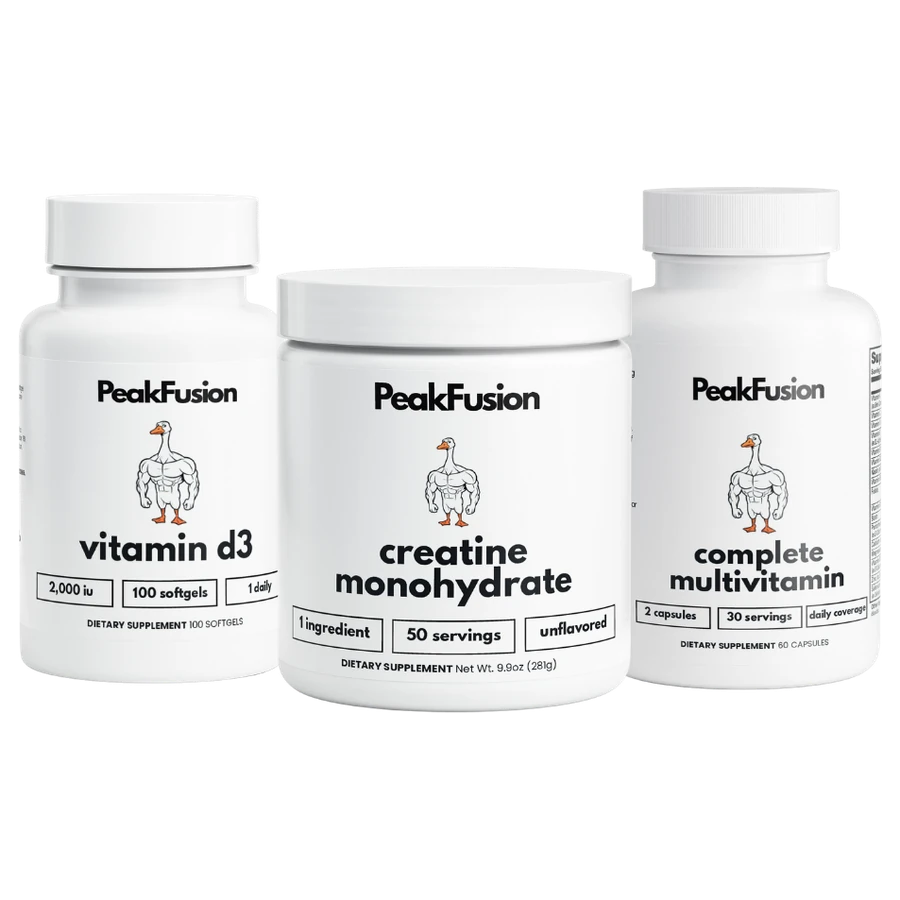


Yes, creatine and vitamin D3 can be taken together. They work through two unrelated systems in the body: creatine is stored in muscle and helps regenerate the energy your muscles burn during short, hard efforts, while vitamin D3 helps your gut absorb calcium and supports normal muscle and nerve function. Neither one competes with the other for absorption, and no published research flags a problem with taking them on the same day. Here is how each one actually works, when to take them, and the one timing detail that is actually worth knowing.
How creatine actually works
Creatine is stored in your muscles mostly as phosphocreatine. During short, intense effort, like a heavy set or a sprint, phosphocreatine donates a phosphate group that helps regenerate ATP, the molecule your muscles burn for energy, faster than your body can produce it from scratch. Taking a creatine supplement raises how much phosphocreatine your muscles can hold, which supports that energy system over weeks of consistent use, paired with training (Examine.com's review of the creatine research). Standard dosing is 3 to 5 grams a day with water, coffee, or any drink, no loading phase required, which matches PeakFusion's own creatine suggested use.
How vitamin D3 actually works
Vitamin D3, also called cholecalciferol, is a fat soluble vitamin your body needs mainly to absorb calcium from food. The National Institutes of Health Office of Dietary Supplements puts it plainly: "your muscles need it to move, and your nerves need it to carry messages between your brain and your body," and a shortage "may lead to weak, painful muscles" (NIH Office of Dietary Supplements, Vitamin D fact sheet). Most adults make some vitamin D from sunlight on their skin, but desk jobs, commutes, and winter at northern latitudes cut that down, which is the reason a daily softgel exists at all.
Why there is no known conflict between them
Creatine and vitamin D3 do not compete for the same absorption route. Creatine is water soluble and absorbed in the small intestine largely as is. Vitamin D3 is fat soluble and needs some dietary fat alongside it to absorb well, a completely different path. Examine.com's page on creatine does not list vitamin D, or any vitamin, as an interaction worth watching. The Trinity Stack, which bundles creatine, vitamin D3, and a multivitamin into one order, states plainly that each product has its own evidence behind it and that no study has tested the three together, not that there is a conflict, just that nobody has run that specific trial. Absence of a flagged interaction is not a guarantee, but for two supplements running through unrelated systems, there is no real mechanism here to raise one in the first place.
Timing: creatine anytime, D3 with a meal
Timing matters more for D3 than it does for creatine, and the reason comes straight back to how each one absorbs.
| Detail | Creatine | Vitamin D3 |
|---|---|---|
| Best taken with | Any liquid, any time of day | A meal that has some fat in it |
| Why | Water soluble, no fat requirement | Fat soluble, absorbs better with food |
| Consistency matters more than | The exact hour you take it | The exact hour, as long as it rides with a meal |
| Can they be taken at the same moment | Yes, nothing about taking them together changes either one | |
Since D3 wants to ride along with food and creatine does not care either way, the simplest routine for most people is to take the D3 softgel with breakfast and the creatine scoop whenever is easiest, whether that is the same cup of coffee at breakfast or a different time later in the day.
What about taking too much
The NIH sets an upper limit for vitamin D, counting every source combined, at 4,000 IU a day for adults, with a recommended daily amount of 600 IU for adults 19 to 70 (NIH Office of Dietary Supplements). PeakFusion's D3 softgel is labeled at 2,000 IU, which sits comfortably under that limit on its own, before counting any D3 that comes from a multivitamin or food. That math, including how it stacks against a multivitamin's own vitamin D content, is covered in more depth in Vitamin D3 and a Multivitamin: Do You Need Both? and How Much Vitamin D3 Do You Actually Need as an Athlete?. Creatine does not carry a comparable published upper limit; the research behind the standard 3 to 5 gram dose has not raised new safety concerns at that amount. Anyone with kidney disease or on prescription medication should check with a doctor before starting either supplement, which is also what PeakFusion's own product pages say.
If you are on the Trinity Stack
PeakFusion's own suggested use for the Trinity Stack already separates these two by habit rather than by any required rule: take the 5 gram creatine scoop with water or coffee any time of day, and take the vitamin D3 softgel with the multivitamin at breakfast, since both of those benefit from riding along with food. That is a convenience pairing, not a safety requirement. Every current lot's test results, creatine lot B25I013 and vitamin D3 lot VS240798, are published with the lot number on the lab results page, so you can match what is in your hand to the actual documentation. The Trinity Stack itself is a one time purchase at $85 with free shipping and does not carry its own subscription, a Shopify platform limit on bundled products rather than a PeakFusion choice. After the first order, each product can be subscribed to on its own schedule.
Frequently asked questions
Does creatine change how my body absorbs vitamin D3?
No. They absorb through different routes, creatine through plain water solubility and vitamin D3 through a fat dependent one, and nothing in the research on either supplement describes the two competing for the same absorption step.
Can I take creatine and vitamin D3 at the exact same moment?
Yes. There is no restriction either way. Many people find it easiest to take the D3 softgel with breakfast and the creatine scoop in the same sitting, since both fit naturally into a morning routine.
Does taking creatine mean I need less, or more, vitamin D3?
No. Creatine does not change your vitamin D requirement. Your actual vitamin D need depends on sun exposure, diet, and latitude, covered directly in How Much Vitamin D3 Do You Actually Need as an Athlete?.
I already take a multivitamin with some vitamin D in it. Does adding creatine change that math?
No, creatine has no vitamin D content and does not factor into that total at all. The multivitamin and D3 softgel overlap is its own question, answered in Vitamin D3 and a Multivitamin: Do You Need Both?.
Where can I check the current lot's test results?
Every current production lot's results, by lot number, are published on the lab results page, including the specific creatine and vitamin D3 lots referenced above.
Shop this
Micronized Creatine Monohydrate: $34 one time, or $28.90 with Subscribe and Save, delivered every 7 weeks.
Vitamin D3 2,000 IU: $26 one time, or $22.10 with Subscribe and Save, delivered every 14 weeks.
The Trinity Stack: $85 one time, includes creatine, the Complete Multivitamin, and the Vitamin D3 softgel, and clears the $75 free shipping threshold. The Trinity Stack is a one time purchase only. Subscribe to each product individually afterward if you want ongoing refills.
This article is general information, not medical advice. Talk to a doctor before starting or combining supplements if you are pregnant, nursing, under 18, or managing a health condition.


