

Most vitamin D3 questions people type into Google are not "does this work." They already believe it works. The real question is "how much," and that question gets a lot more common every year once the days start getting shorter.
Our Vitamin D3 softgel is labeled at 2,000 IU. That number is correct and it is what you should go by. But it helps to actually understand what it means, how it compares to what health authorities recommend, and when it might make sense to talk to a doctor about taking more. Here is the honest breakdown, without a made-up number attached to it.
Why this question picks up every fall
Your body makes most of its own vitamin D when skin is exposed to UVB sunlight, not from food or supplements. As the sun sits lower in the sky and days get shorter, that process slows down for almost everyone, not just people who live somewhere cloudy. Add in more time training indoors, more layers of clothing outdoors, and less total daylight, and it is easy to see why vitamin D levels drift downward through the fall and winter months even in people who were not thinking about it at all over the summer.
This is not a PeakFusion talking point. A 2020 study published in the Journal of Nutritional Science followed 47 university athletes in the United Kingdom, split between indoor and outdoor sports, and measured their blood vitamin D levels in both autumn and spring. Average levels dropped significantly between the two seasons, and by spring, roughly a third of the athletes measured below the threshold researchers used to define deficiency. The athletes training indoors were not meaningfully better off than the ones training outside, since UK winters do not provide much usable UVB light either way. The takeaway is not that athletes are unusually fragile. It is that the season itself, not the sport, is the bigger variable. We cover the deficiency side of this in more depth in why vitamin D deficiency shows up so often in athletes. This piece is about the other half of the question: once you know you might be short, how much should you actually be taking.
What "2,000 IU" on the label actually means
IU stands for International Unit, a standardized measurement used for vitamins and a few other compounds where a plain weight measurement (like milligrams) would not be consistent across different chemical forms. For vitamin D specifically, 2,000 IU is equal to 50 micrograms.
Our softgel uses cholecalciferol, which is the D3 form your own skin produces and the form most research on vitamin D supplementation is actually built on, rather than D2 (ergocalciferol), a plant-derived form that is less effective at raising blood vitamin D levels per the same dose. The label claim is what we can currently stand behind for our current production lot. That lot has completed independent heavy-metals screening, but its potency assay (the lab test that measures exactly how much active D3 is actually in each softgel) has not been completed yet, so we are not publishing a measured number for it. We would rather tell you that plainly than carry over a figure from an older, retired lot just to have a bigger number to print.
How much do you actually need
According to the National Institutes of Health Office of Dietary Supplements, the Recommended Dietary Allowance (RDA) for vitamin D is 600 IU per day for most adults, rising to 800 IU per day after age 70. The RDA is designed to cover the needs of nearly everyone in a given group, which means it already has a built-in margin above what the "average" person strictly needs.
Our standalone softgel is dosed well above that RDA floor, at 2,000 IU. That is a deliberate choice, not an oversight. A single daily RDA-level dose assumes you are getting some vitamin D from food and sun exposure too, and for a lot of people, especially through the darker months described above, that assumption does not hold up. A higher maintenance dose closes more of that gap on its own, without requiring you to also track sun exposure and dietary intake to get there.
The same NIH fact sheet lists the tolerable upper intake level (the highest daily amount considered safe for long-term use in the general population) at 4,000 IU per day for adults, from all sources combined, including food, sun, and supplements. A single 2,000 IU softgel uses half of that ceiling on its own, which is worth knowing if you are also eating fortified foods or taking a separate multivitamin with some vitamin D in it. Our own Complete Multivitamin contains 400 IU of vitamin D as part of its broader micronutrient panel, on top of whatever the standalone softgel provides, and we walk through that exact math in our piece on combining creatine, a multivitamin, and vitamin D3.
When more than 2,000 IU might make sense, and why that is not a default
Some people, particularly those with a confirmed deficiency, limited sun exposure, darker skin (which produces vitamin D less efficiently from the same sun exposure), or certain digestive conditions that affect fat absorption, are prescribed higher short-term doses by a doctor to correct a deficiency before stepping back down to a maintenance amount. That is a decision made with an actual blood test, not a guess based on how tired someone feels in January.
The only reliable way to know your own vitamin D status is a blood test that measures 25-hydroxyvitamin D, usually written as 25(OH)D, which is the form of vitamin D that circulates in your blood and reflects what your body actually has on hand, not just what you swallowed that morning. If you suspect you are low, that test and a conversation with a doctor is the right next step before increasing your dose beyond what is on the label, since the gap between a maintenance dose and a therapeutic one is usually a decision for a clinician, not a supplement label.
Frequently asked questions
Is D3 actually better than D2?
For raising and maintaining blood vitamin D levels, yes. D3 (cholecalciferol) is generally more effective per IU than D2 (ergocalciferol), which is part of why it is the form used in most over-the-counter vitamin D supplements, including ours.
Should I take it with food?
Vitamin D is fat-soluble, meaning it absorbs better alongside a meal that contains some fat, rather than on an empty stomach. There is no requirement around the time of day, just around pairing it with food.
Does it matter if I already take a multivitamin?
It is worth doing the math rather than assuming, since a lot of multivitamins, including ours, include some vitamin D on their own label. See the section above and our full breakdown on stacking creatine, a multivitamin, and D3 for the specific numbers.
Why don't more brands publish a "pending" assay the way you do?
We cannot speak for other brands. We can say that our lab results page is updated by lot number, not by marketing cycle, and when a figure is not confirmed yet, the honest move is to say so rather than fill the gap.
shop this
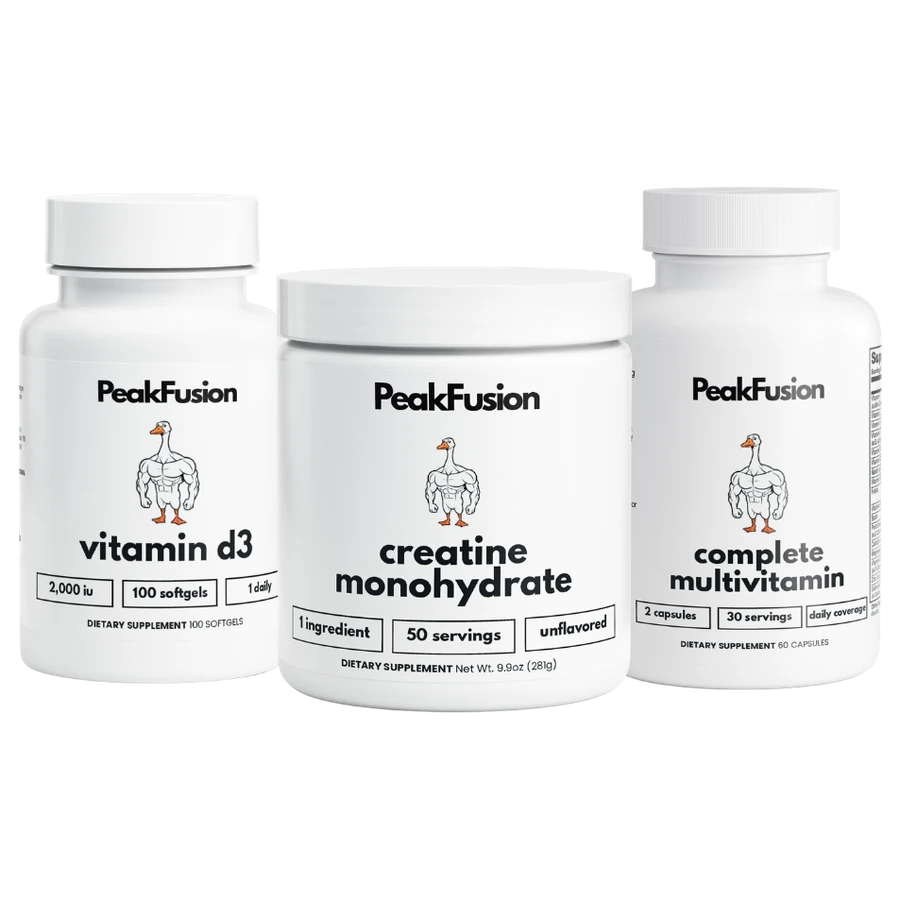
our Vitamin D3 2,000 IU softgel is $26 one time, or $22.10 when you subscribe and save 15%, refilling automatically every 14 weeks so you are not reordering mid-winter when you need it most. it also comes bundled into the Trinity Stack with creatine and our Complete Multivitamin for $85, if you are starting all three at once.
this is general information, not medical advice. talk to a doctor before starting any new supplement or increasing your dose beyond the label, especially if you are pregnant, nursing, or managing a health condition.