


updated october 2026
short answer: yes. creatine and a multivitamin are commonly taken together, and there is no published research showing a negative interaction between creatine monohydrate and standard multivitamin supplementation. they work through completely different pathways in the body, so there is no obvious reason for them to interfere with each other.
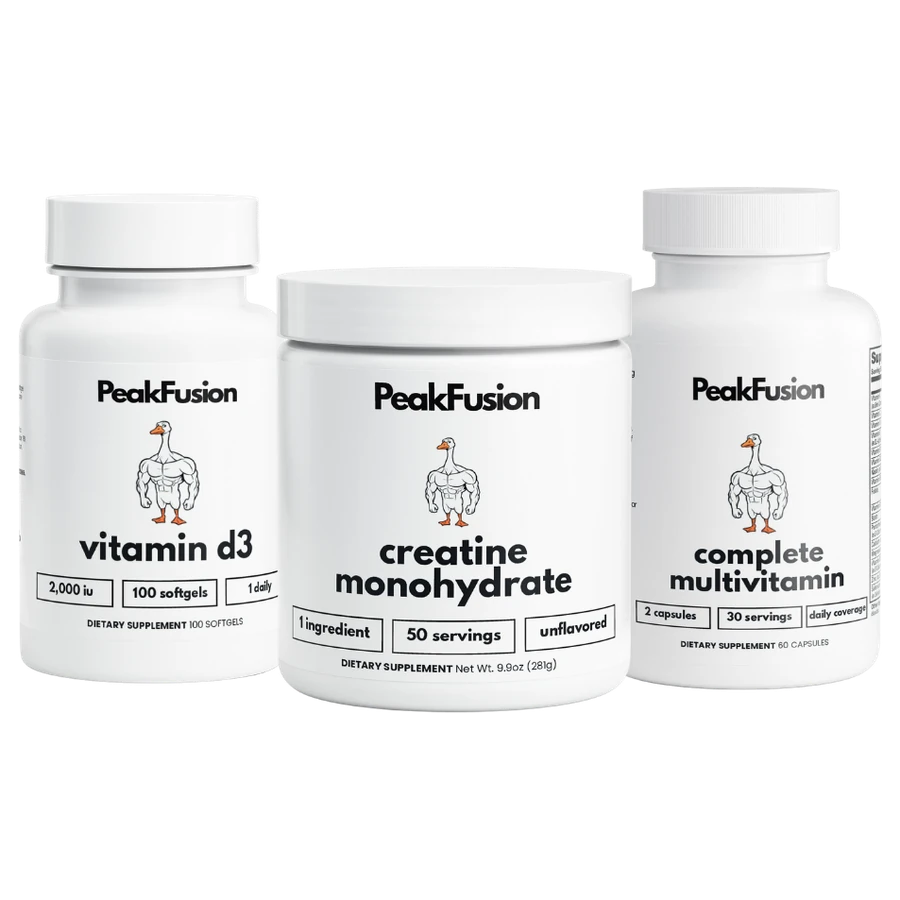
that said, "safe to combine" is not the same as "nothing to think about." if you take creatine and a multivitamin at the same time, or you are looking at the Trinity Stack as a way to start both at once, there are a few real questions worth answering: does timing matter, does one affect how well the other absorbs, and is there anything in a multivitamin that could double up with a separate vitamin D3 supplement. here is what we know, in plain terms.
why this question comes up so often
creatine is one of the most studied supplements in sports nutrition, and a complete multivitamin is one of the most common supplements in general. put the two together and a lot of people, especially athletes stacking supplements for the first time, want a straight answer before they start. the confusion is not really about safety. it is about not knowing whether two products bought separately are designed to work alongside each other or whether one cancels out the other. if you are also weighing which form of creatine to buy in the first place, our creatine monohydrate vs. creatine HCL comparison covers that decision on its own.
they are not designed around each other, and they do not need to be. creatine monohydrate is a single compound that the body stores mostly in muscle tissue, where it helps regenerate a molecule called ATP (adenosine triphosphate), the basic energy currency your cells use during short, high-effort movements like sprinting or lifting. a multivitamin is a mix of micronutrients meant to cover day-to-day nutritional gaps, not an energy source or a performance compound in the way creatine is. different job, different mechanism, no competition for the same biological process. if you are new to creatine and wondering when you will actually notice it working, we cover that separately in how long creatine takes to work, and if you also drink coffee, creatine and caffeine together covers that pairing.
what the research actually says about combining them
the International Society of Sports Nutrition's 2017 position stand on creatine, one of the most cited safety reviews on the compound, covers dosing, long-term use, and interactions with other common training compounds. it does not flag multivitamin co-ingestion as a concern, and no controlled study has reported reduced creatine uptake or reduced vitamin absorption when the two are taken in the same sitting. vitamin and mineral absorption research generally centers on interactions between specific nutrients (iron and calcium competing for the same transporter is a well-documented example), not on creatine, which is not a vitamin or mineral and does not use those same absorption pathways.
none of that is a claim that combining them makes either one work better or faster. it is simply the honest state of the evidence: no known interaction, no requirement to separate the two, no special sequencing needed.
does timing matter?
not in any way that requires planning around. you can take creatine and a multivitamin at the same time, at different times of day, or on completely different schedules, and it will not change how either one works. two practical notes, both about digestion rather than interaction:
fat-soluble vitamins, meaning A, D, and E, tend to absorb better when taken with a meal that has some fat in it, which is why a multivitamin's own instructions usually say to take it with food. creatine has no such requirement, but taking it on an empty stomach is more likely to cause mild stomach discomfort in some people, so pairing it with a meal, the same one where you take your multivitamin, is a reasonable default rather than a rule. if coffee is part of that morning routine, taking a multivitamin with coffee is its own question worth a direct answer, separate from creatine.
the one overlap worth actually checking: vitamin D
this is the part most generic advice on this topic skips, and it is the one place where "just take them together" deserves a second look if you are combining our Complete Multivitamin with our standalone Vitamin D3 softgel, including through the Trinity Stack. we cover the full version of this math, with more detail on when stacking actually makes sense, in vitamin D3 and a multivitamin: do you need both, and the creatine-specific side of that same question is covered separately in can you take creatine and vitamin D3 together. the short version:
| source | vitamin D | % of adult RDA (600 IU) | % of adult UL (4,000 IU) |
|---|---|---|---|
| Complete Multivitamin alone | 400 IU | 67% | 10% |
| Vitamin D3 softgel alone | 2,000 IU | 333% | 50% |
| both together | 2,400 IU | 400% | 60% |
the RDA and UL figures above come from the NIH Office of Dietary Supplements' vitamin D fact sheet: 600 IU a day for adults 19 to 70, and a tolerable upper intake level of 4,000 IU a day for adults 19 and older, from all sources combined. taking both PeakFusion products together lands at 60% of that ceiling, with room left for whatever vitamin D you get from food or sun. it is worth knowing the math rather than assuming you are starting from zero every time you add a new supplement, and worth bringing the actual numbers to a doctor or pharmacist if you take prescription medication, have a health condition, or get meaningful vitamin D from another source already.
what about hydration?
creatine draws water into muscle cells as part of how it is stored there, which is different from the body holding water under the skin. general nutrition guidance recommends adequate daily fluid intake for anyone training regularly, creatine or not, and that guidance does not change just because you have also added a multivitamin. neither product substitutes for training or for basic hydration habits. the training does the work. the stack supports it.
what we publish, and why it matters here
every PeakFusion product ships from an FDA-registered, cGMP-compliant facility (cGMP means current Good Manufacturing Practices, the federal quality standard for how supplements are made). for each product, we publish the test results for the current production lot, with its lot number, so you can match what you are holding to the actual documentation. for creatine, that means an assay result (a lab measurement of exactly how much active compound is in the product) checked against the label claim. for the multivitamin, it means HPLC results (a method that measures how much of a vitamin is actually present) on the label claims profiled for that lot, plus heavy-metal and microbiological screening. the current lot numbers and full results are published on our lab results page, and we would rather point you there for the live figures than print a number in this post that goes stale the next time a lot rotates.
frequently asked questions
does creatine cancel out a multivitamin, or the other way around?
no. no controlled study has reported either product reducing the other's absorption or effect. they use different pathways in the body.
can you take both at the exact same time, or should you space them out?
you can take them together. the only timing note that matters is digestion, not interaction: a multivitamin's fat-soluble vitamins absorb better with a meal, and creatine is gentler on the stomach with food too, so pairing them at a meal is a convenience, not a requirement.
if you take both plus the standalone vitamin D3 softgel, is that too much vitamin D?
no, for most adults. the combined total is about 2,400 IU a day, which is 60% of the 4,000 IU upper intake level the NIH sets for adults. it is still worth doing the math if you get meaningful vitamin D from another source.
does the Trinity Stack already cover this combination?
yes. the Trinity Stack bundles creatine, the Complete Multivitamin, and the Vitamin D3 softgel in one order, so if you are starting all three, the combination question above is the one that applies to you.
who should check with a doctor before combining creatine and a multivitamin?
anyone who is pregnant or nursing, takes prescription medication, or manages a health condition. our multivitamin also contains botanical ingredients, including saw palmetto, green tea extract, garlic, and echinacea, which is worth mentioning to a doctor or pharmacist if you take blood thinners, since botanicals are more likely than isolated vitamins to interact with certain drugs. creatine is not something we market to anyone under 18; that is a conversation for a parent and a doctor, not a supplement purchase.
the simple version
creatine and a multivitamin are safe to take together, do not need to be timed apart, and are not known to interfere with each other in any documented way. the one thing actually worth checking, if you are combining our full product line, is total vitamin D intake between the multivitamin and the standalone D3 softgel, and that math comes out well under the established safety ceiling for most adults. beyond that, this is less about finding a hidden risk and more about not overthinking a combination that was never a problem to begin with.
shop this
the Trinity Stack is the simplest way to start all three: creatine, complete multivitamin, and vitamin D3, in one $85 order with free shipping. it's a one-time purchase to start, so once you know it works for you, subscribe to each product individually and they will each refill on their own schedule, creatine every 7 weeks at $28.90, the multivitamin monthly at $28.90, and D3 every 14 weeks at $22.10, all 15% off the one-time price.
this is general information, not medical advice. talk to a doctor before starting any new supplement, especially if you are pregnant, nursing, or managing a health condition.


