


Updated October 2026.
At a standard 5 gram daily dose with no loading phase, creatine takes about three to four weeks to fully saturate your muscle stores. With a loading phase, that drops to about one week, then you settle into the same maintenance dose. Either way you end up in the same place: full stores that support short, hard efforts in training.
Creatine does not work the way most supplements are marketed. There is no caffeine-like hit and no feeling of something kicking in. What creatine does is gradually fill the creatine stores in your muscles, and once those stores are full, it supports your performance in short, hard efforts.
Why Creatine Takes Time: The Phosphocreatine System
Your muscles run on adenosine triphosphate (ATP) during high-intensity effort like sprinting, heavy lifting, and jumping. ATP runs low within seconds, and phosphocreatine is the fastest way to rebuild it. Taking creatine monohydrate raises the phosphocreatine stored in your muscles, which helps you hold your output a little longer before fatigue sets in.
Muscles can only hold so much, and reaching that ceiling takes steady daily intake. That is why the timeline is weeks, not days. You are not waiting for something to kick in. You are waiting for a tank to fill.
Once your stores are full, the effects show up in training: an extra rep at the same weight on some sets, and better output in short, all-out efforts. The International Society of Sports Nutrition calls creatine monohydrate the most effective ergogenic nutritional supplement currently available to athletes, based on several hundred peer-reviewed studies (Buford et al., 2007).
Loading vs. No Loading: Side by Side
| No loading (recommended) | Loading phase |
|---|---|
| 5 grams, once a day, from day one | About 20 grams a day (5g x4), for 5 to 7 days, then 3 to 5 grams a day |
| Full muscle saturation in about 3 to 4 weeks | Full muscle saturation in about 1 week |
| Easier on the stomach, no split dosing | Some people get an upset stomach while loading |
| Simpler, the default PeakFusion recommends | Reaches the same end point faster, useful if an event is close |
Loading does not produce better long-term results than the standard daily approach (Kreider et al., 2017). It only changes how fast you get there.
A Week-by-Week Timeline (5 Grams a Day, No Loading)
Week 1
Creatine is starting to build up in your muscles, and you will probably notice nothing. Some people see the scale move up slightly from extra water held inside their muscle cells. That is normal.
Weeks 2 and 3
Your muscle stores are rising. Some people notice an extra rep or two on hard sets, or that their output holds up a little longer in short intervals. If you notice anything, it will be subtle.
Week 4 and Beyond
By about week four, your stores are usually full at this dose. From here, the benefit comes from training consistently while your stores stay topped up. Keep taking it every day, because your stores drift back to baseline over several weeks after you stop.
Why You Might Not Notice Results Yet
Missed days. Creatine works by keeping your stores full, so skipping days slows things down. Take it at the same time every day, whenever it fits: with your morning coffee, after training, or with dinner. If missed days keep happening around the same point in the month, a standing subscription removes that gap entirely; see the math on whether subscribing is worth it.
Too small a dose. The research-supported daily dose is 3 to 5 grams. Some products mix creatine into a blend without listing how much is in each serving, so you cannot tell whether you are getting that much. PeakFusion is 5 grams of creatine monohydrate per scoop, with nothing else in the formula.
No way to check the product. If a creatine has not been third-party tested, you cannot confirm what is in the tub. PeakFusion's current lot, B25I013, was independently tested at 100.8% assay, against a 99.9% minimum specification.
Training that does not call on it. Creatine helps most in short, high-intensity efforts. If your training rarely pushes hard sets close to failure, there is less for it to support. The training has to do the work.
Does Timing Matter?
The research on timing is mixed. Some studies suggest taking creatine after training may have a small edge, and others find no meaningful difference. Taking it every day matters far more than when you take it. If you tend to forget, pair it with something you already do daily, including your morning coffee; see whether creatine and caffeine can be taken together if that is your routine.
Creatine and Water Weight
Creatine pulls some extra water into your muscle cells. That is part of how it works, not a side effect. It is water inside the muscle, not the puffy, under-the-skin look people associate with bloating. The scale may tick up a little in the first few weeks, so if you track your weight closely, it helps to know that going in.
Frequently Asked Questions
Can you feel creatine working?
Not directly. There is no stimulant effect. What you notice, if anything, is indirect: an extra rep on a hard set, or holding your output a little longer late in a session, once your stores are full.
What happens if you miss a few days?
Muscle creatine stores drift down gradually, not immediately. A missed day or two will not undo weeks of saturation, but a pattern of missed days slows how full your stores stay and delays the benefit.
Is loading safe?
The loading protocol described in the research, about 20 grams a day split into four doses for 5 to 7 days, is well studied and considered safe for healthy adults. Some people experience mild stomach discomfort at that dose, which is why it is optional rather than required.
Do you need to cycle creatine, taking breaks every few months?
No. Continuous daily use at a 3 to 5 gram maintenance dose is what the long-term research is actually built on, not a cycle-on, cycle-off pattern.
Does a bigger dose work faster?
Only up to the loading-phase amount described above. Beyond that, muscle creatine storage has a ceiling, so doses higher than what loading already uses do not saturate stores any faster and mostly just pass through unused.
The Bottom Line
Creatine works on a timeline of weeks, not hours. At 5 grams a day without loading, give it three to four weeks. With a loading phase, about one. Either way you end up in the same place: full muscle stores that support your training in short, hard efforts.
Consistency is what matters. Take 5 grams every day, keep training, and give it a month. The training drives the results; creatine's job is to keep your stores full enough to support it.
If you are deciding between creatine forms, see our creatine monohydrate vs. creatine HCL comparison, or if you take creatine with a daily multivitamin, see whether you can take them together.
Shop This
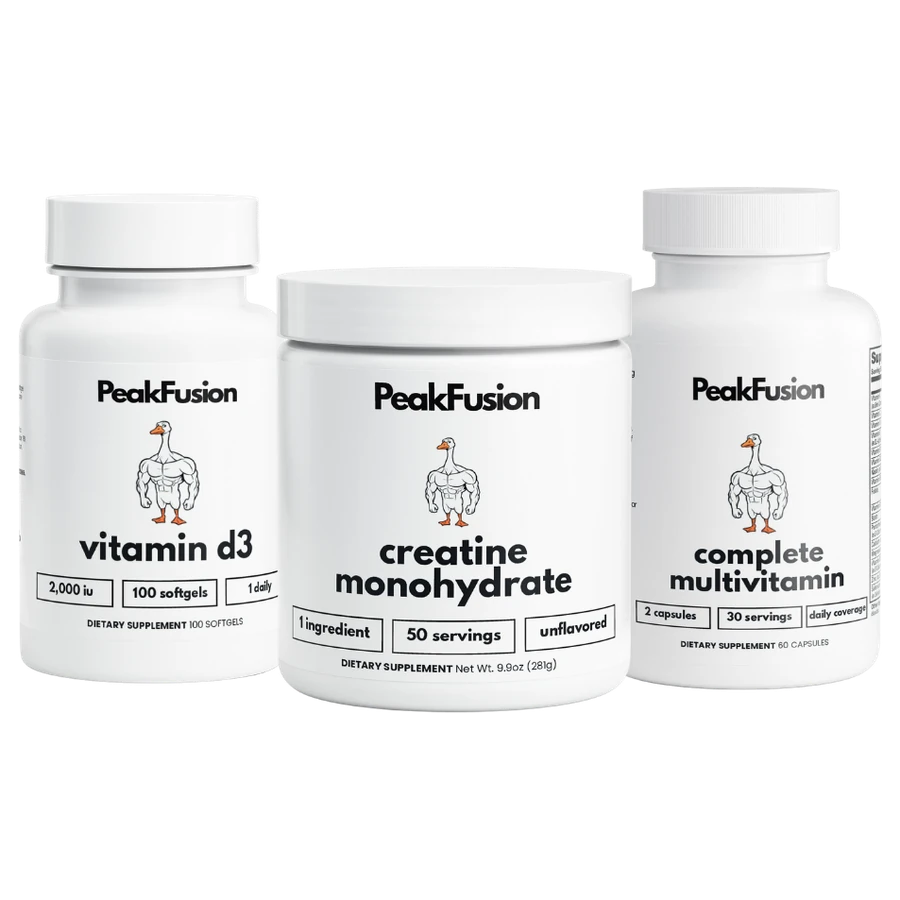
PeakFusion Micronized Creatine Monohydrate is 5 grams per serving, unflavored, and independently tested at 100.8% assay (Lot B25I013). $34 one-time, or $28.90 with subscribe and save, delivered every 7 weeks, so the next scoop shows up before the last one runs out. Orders of $75 or more ship free in the US. The Trinity Stack bundles creatine with the multivitamin and Vitamin D3 for $85 one-time and clears that threshold on its own; it does not carry its own subscription, so the way to keep it on autopilot afterward is to subscribe to each product individually.
PeakFusion supplements are not drugs and make no disease-related claims of any kind. Consult a healthcare provider before beginning any supplement. PeakFusion creatine is for adults 18 and older.


