

Walk into any supplement store and you will find creatine marketed in a dozen forms. Creatine HCL. Buffered creatine. Creatine ethyl ester. Kre-Alkalyn. Each claims superior absorption, less bloating, or better results with smaller doses. The marketing gets more sophisticated every year.
Then there is creatine monohydrate, the original, the most studied, and by most measures the most effective form available. Here is what the evidence actually says, including the head-to-head research that most comparison articles skip.
The Research Baseline: 500+ Studies on One Form
Creatine monohydrate has been studied more extensively than virtually any other dietary supplement. The body of research spans over 500 peer-reviewed studies across more than three decades, examining effects on strength, power output, muscle mass, exercise recovery, and cognitive function.
The International Society of Sports Nutrition (ISSN) position stand on creatine explicitly states that creatine monohydrate is "the most effective ergogenic nutritional supplement currently available to athletes." That recommendation is based on monohydrate specifically, not creatine as a general category.
What Is Creatine HCL?
Creatine HCL (hydrochloride) is creatine bound to a hydrochloride group to improve water solubility. It was developed in the early 2000s and marketed primarily around two claims: higher solubility means better absorption, and lower doses are required compared to monohydrate.
The solubility claim is accurate. Creatine HCL does dissolve more readily in water. The absorption claim is where the science gets complicated.
How Creatine Actually Gets Into Muscle
Creatine does not passively soak into muscle tissue. It is carried in through a specific transport protein called the creatine transporter, or CreaT1, which sits on the surface of muscle cells and moves creatine from the bloodstream into the cell. This transporter has a limited capacity. Once muscle creatine stores approach saturation, the transporter slows down regardless of how much creatine is circulating in the blood or how quickly it dissolved going in.
This matters because the entire marketing case for creatine HCL rests on the idea that better solubility in a glass of water translates to better uptake at the transporter. Solubility describes how a substance behaves in liquid before it is swallowed. Bioavailability, a term for how much of a substance actually reaches active use in the body, is a separate question decided largely by the transporter, not the glass. There is no published evidence that creatine HCL saturates the transporter faster or more completely than monohydrate does.
Absorption: What the Evidence Actually Shows
Creatine monohydrate is absorbed at approximately 99 percent efficiency when consumed with water and adequate carbohydrates. Gastrointestinal complaints with monohydrate, namely bloating and cramping, typically stem from large single doses during aggressive loading phases, not from the compound itself. At the standard 3 to 5 gram maintenance dose, these complaints are rare.
The Head-to-Head Evidence
A 2022 systematic review published in the Journal of Strength and Conditioning Research examined every available study on alternative forms of creatine marketed on absorption or dosing claims, the same category creatine HCL is sold under, comparing them to monohydrate for performance and body composition outcomes. Only 3 of the 17 studies reviewed made a direct head-to-head comparison against monohydrate, and the review found no consistent evidence that any alternative form outperformed it. The authors concluded that creatine monohydrate "remains the most extensively studied form of creatine that shows efficacy, safety, and lowest cost to consumer."
An earlier analysis in the journal Amino Acids reached a similar verdict after reviewing novel creatine formulations, including creatine ethyl ester and various creatine salts marketed on absorption claims. The researchers found little to no evidence that any of the newer forms were more effective or safer than monohydrate, and flagged that creatine ethyl ester actually degrades into creatinine, a waste product, when exposed to the low pH of the stomach.
A controlled trial in the Journal of the International Society of Sports Nutrition put that ethyl ester finding to the test directly: 30 untrained men completed seven weeks of resistance training on either a placebo, monohydrate, or ethyl ester. Blood work confirmed the concern, with ethyl ester users showing serum creatinine levels roughly three times higher than the monohydrate group, consistent with degradation before the creatine could be used. Strength and body composition improved by a similar amount across every supplemented group, which the researchers attributed to the resistance training itself rather than to which creatine form the group happened to take. That is the pattern worth remembering with any creatine comparison: the training drives the results, and the supplement's job is to support recovery and stored energy for the next session, not to manufacture gains on its own.
No large-scale, independent, peer-reviewed study has shown creatine HCL produces meaningfully greater increases in muscle creatine content or performance outcomes than monohydrate at equivalent doses.
Loading Phase or Not? Dosing Protocols Compared
Both forms are typically sold with one of two dosing approaches. A loading protocol front-loads roughly 20 grams per day, split into smaller servings, for five to seven days, then drops to a 3 to 5 gram daily maintenance dose. A no-loading protocol skips straight to the 3 to 5 gram daily dose from day one.
Loading saturates muscle creatine stores faster, typically within a week instead of three to four weeks, but does not change the final saturation point either form reaches. For most people training consistently, the no-loading approach is the more comfortable starting point since it avoids the higher gastrointestinal load of the front-loaded doses. Either way, consistency day to day matters more than which protocol you pick.
Cost: The Practical Difference
Creatine HCL typically costs three to four times more per gram of active creatine than monohydrate. If you need 5 grams of monohydrate daily, manufacturers suggest 1 to 2 grams of HCL achieves the same effect, but that dosing comparison relies entirely on the unproven absorption superiority argument. If the argument does not hold, you are paying significantly more for an alternative form with far less research behind it.
Purity: What to Actually Look For
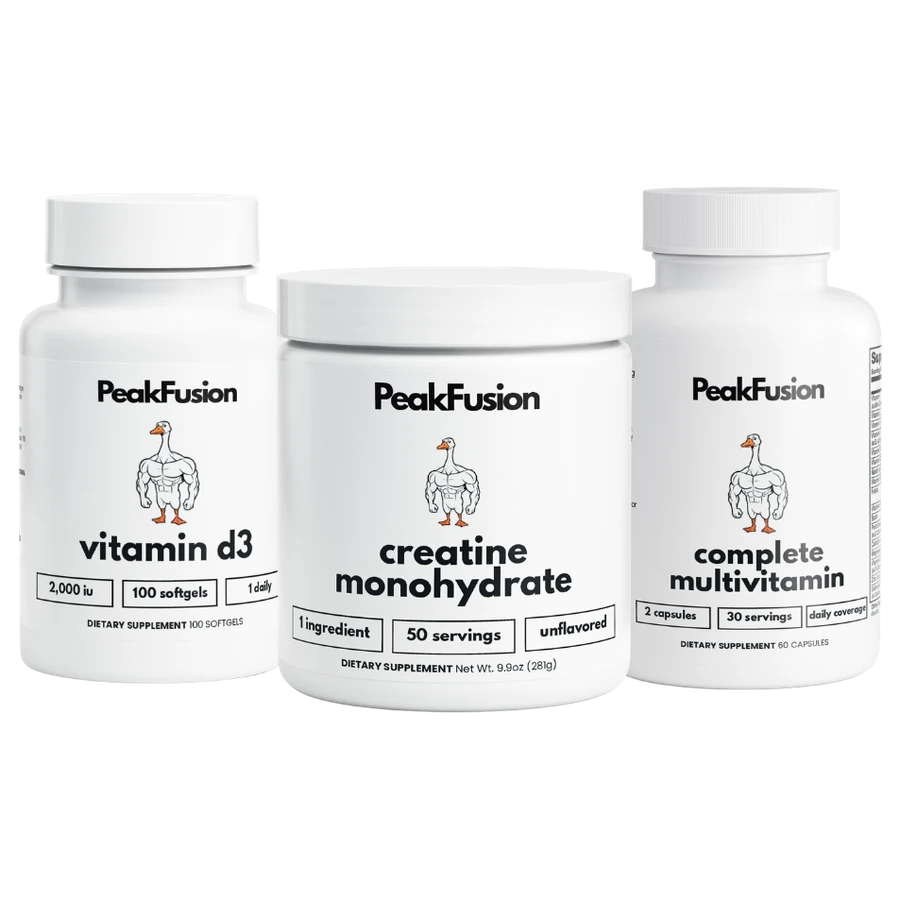
Whatever form of creatine you choose, purity matters more than the marketing on the label. Third-party testing via HPLC, a lab method that separates and measures individual compounds in a sample, is the standard way to verify creatine purity. An assay result, meaning the measured percentage of active creatine in the product, above 99 percent from an independent laboratory is the quality benchmark. PeakFusion's Micronized Creatine Monohydrate tested at 100.8 percent assay against a 99.9 percent minimum specification on Lot B25I013, verified by an independent third-party lab with zero heavy-metal or microbiological flags, with the full Certificate of Analysis publicly available by lot number.
Frequently Asked Questions
Is creatine HCL better than monohydrate? No independent, peer-reviewed research has shown it produces greater strength, muscle, or performance gains than monohydrate at an equivalent effective dose. It dissolves more easily in water, which is a real but minor convenience, not a performance advantage.
Do I need to cycle creatine, taking breaks every few months? The ISSN position stand does not recommend cycling. Continuous daily use at a maintenance dose is what the long-term safety research is actually built on.
Can I switch from monohydrate to HCL, or the other way around? Yes. Since neither form has shown a meaningful performance edge over the other, switching is mostly a matter of personal preference around mixability and price, not a decision that changes results.
Does creatine HCL cause less bloating? Bloating with monohydrate is associated with high-dose loading phases, not the compound itself. Skipping the loading phase and taking a standard 3 to 5 gram daily dose resolves most bloating complaints regardless of which form is used.
The Verdict
Creatine monohydrate has more than 500 peer-reviewed studies behind it, near-complete absorption efficiency at standard doses, and the explicit endorsement of the International Society of Sports Nutrition. The most recent systematic review of alternative forms, published in 2022, found no consistent evidence that any of them, HCL included, outperforms it.
Creatine HCL may dissolve more easily. But dissolving more easily is not the same as working better, and no independent research supports paying a premium for that difference. For most athletes, micronized creatine monohydrate dosed at 3 to 5 grams daily remains the most evidence-supported, cost-effective choice available.
Once you have picked a form, two related questions are worth answering next: how long it takes to actually work, and whether it is safe to stack with a daily multivitamin.
Shop This
PeakFusion's Micronized Creatine Monohydrate is 5 grams per serving, unflavored, and tested by an independent lab with every lot's Certificate of Analysis published. Subscribe and save 15 percent, refilled automatically every 7 weeks, or buy it once to try it first.